
Why can't I relax? (and why rest can feel uncomfortable)
You finally have a free evening and can't settle. Here's why rest can feel uncomfortable, and a two-minute experiment that doesn't ask you to relax on demand.

If you can't relax, you're not broken. After long stretches of busy mode, stillness can feel unfamiliar, restless or even unsafe, because your mind and body are used to being on. That's common, and there are gentle ways to practise rest.
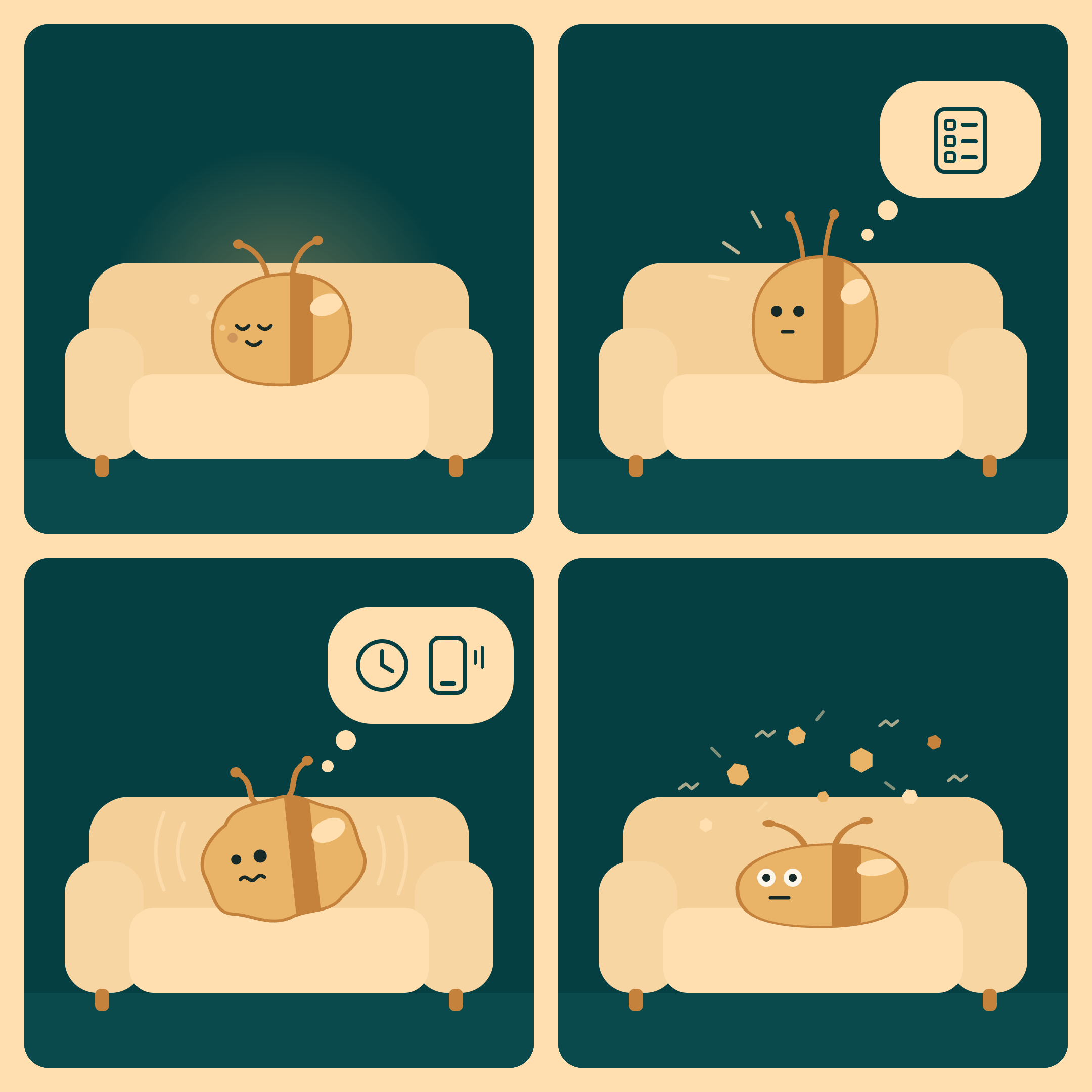
You've cleared the diary. The washing is on, the inbox is closed, and you've promised yourself an hour on the sofa doing absolutely nothing. Four minutes in, you're mentally rewriting the shopping list, checking the time and wondering whether it's too late to sort out the cupboard under the stairs.
Here's the strange part. You wanted this. You even looked forward to it. And now it's here, rest feels less like a treat and more like a test you're failing.
If that's you, nothing is wrong with you. Feeling uncomfortable when you stop is a very ordinary response to a very full life, and it's worth understanding rather than fighting.
What is going on when relaxing feels uncomfortable?
There's no tidy name for it. It's the gap between "I'm finally allowed to rest" and "my body has no idea what to do with that." It tends to show up in ways like these:
- Your hands keep reaching for your phone, a snack or the nearest job.
- A quiet hum of "I should be doing something" sits behind everything.
- The to-do list reappears the moment you sit down, in full colour.
- You feel flat or edgy, neither properly relaxed nor properly upset.
- You decide the whole idea is pointless and get up again.
None of this is a diagnosis. It's a description of what slowing down can feel like when you've been going flat out for a while, and it's far more common than the glossy "self-care Sunday" version of rest would suggest.
Four common reasons rest can feel strange
There isn't one cause, and we can't tell from the outside which is yours. But four come up again and again, and you may recognise more than one.
Busy mode has become your default
Think of an engine that's been left running for weeks. Turn the key and it doesn't go silent at once. It shudders, rattles, and settles, if it's allowed to. When most of your days are "on" (work, messages, the kids, the next thing), "off" becomes the unfamiliar setting. Your body isn't refusing to rest. It just hasn't had much practice lately.
If your body stays switched on even when you're exhausted, tired but wired goes into that in more detail.
Stillness lets the noise in
During the day, busyness works as a very effective volume knob. Emails, errands and conversations keep the thoughts you can't deal with politely queuing. Sit down at 8pm and the queue surges forward: the awkward conversation, the money thing, whether you ever replied to that message.
This isn't your mind ambushing you. It finally has a free moment to hand over everything it's been holding. It just has a flair for the dramatic.
Rest can feel unearned
Many of us learn, without anyone saying it out loud, that our worth is tied to being useful. So resting before everything is done feels a bit like eating pudding before dinner. You can do it, but there's a voice. "I should be doing something" is productivity guilt, and it's so common that it barely registers as a thought. It just sits there making the sofa less comfortable than it looks.
Notice that nobody has actually told you that you haven't earned a break. That's usually your own inner manager working overtime.
Relaxing can feel unsafe: relaxation-induced anxiety
This one has a proper name, so we'll use it once. Relaxation-induced anxiety is when trying to relax makes some people feel more tense or uneasy, not less. It isn't an official diagnosis, but it has been described since the early 1980s, when researchers Heide and Borkovec found that some people taught relaxation techniques felt more tense while practising them.
One idea about why, from researchers who study worry, is that for some people who are prone to it, calm can feel like a sudden drop they'd rather not take. The worrying carries on as a kind of insurance, and relaxing interrupts it, as Medical News Today explains.
That's an idea, not a verdict, and it describes an experience rather than labelling you. If it happens often or feels distressing, a GP or therapist can help.
Three everyday examples
- Day one of a holiday. You've finally landed, and instead of unwinding you feel oddly flat, or on edge, or you've already researched what's near the hotel. Your body is still on the commute.
- Sunday afternoon. It looks like a gift until about 3pm, when Monday starts leaning on the door and the rest you were meant to be having turns into dread-with-snacks.
- The sofa with the phone. You sit down to rest and pick up your phone "for a second". Forty minutes later you're not rested, and you're not entirely sure what you've been looking at. Scrolling isn't really rest. It's busy mode in slippers.
A gentle experiment: sit with it for two minutes
Here's the idea. You can't force yourself to relax. Trying to is a bit like trying to fall asleep faster by shouting at your pillow. So instead of making the restlessness go away, give it two minutes of your company.
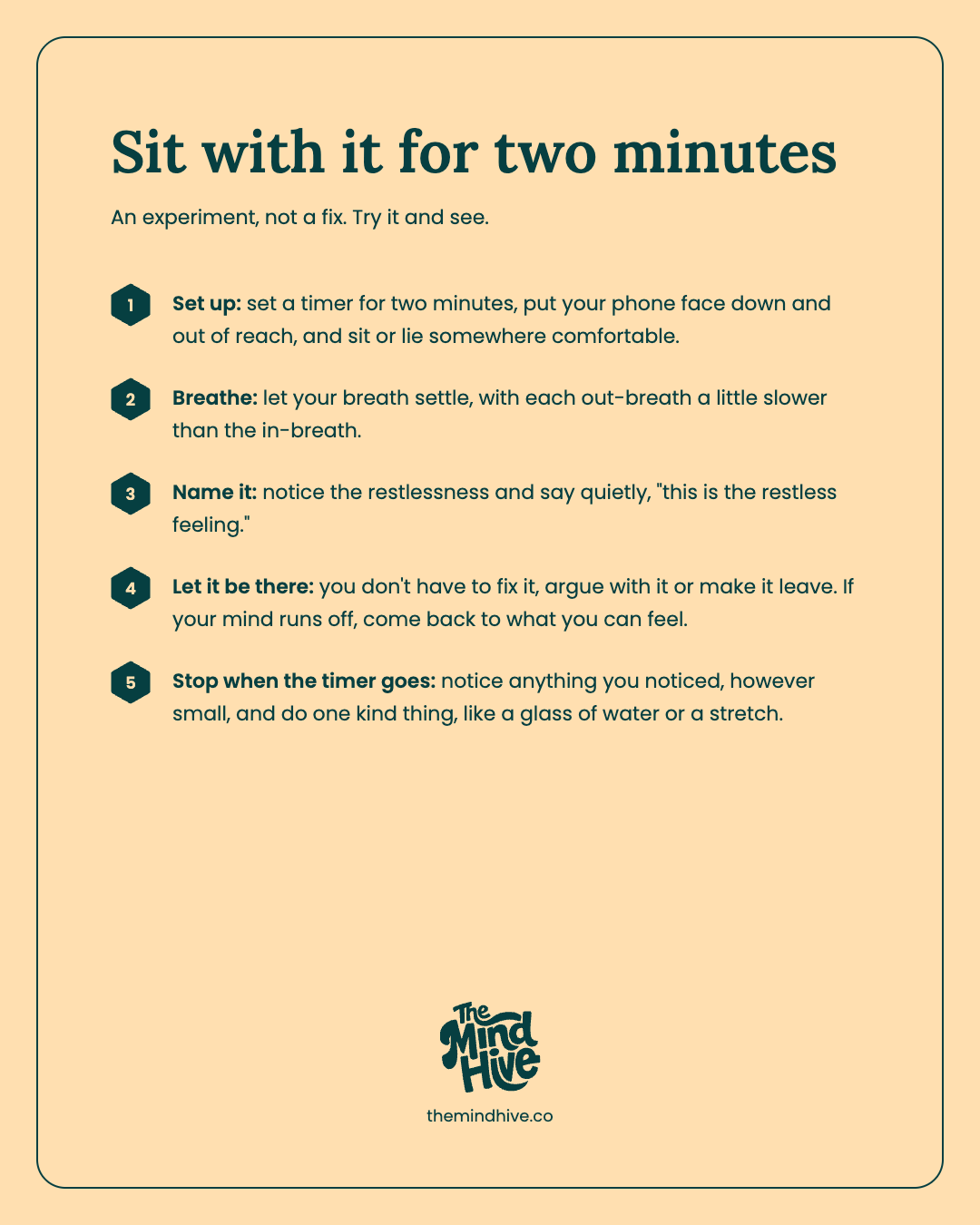
This is an experiment, not a fix. Try it and see what happens.
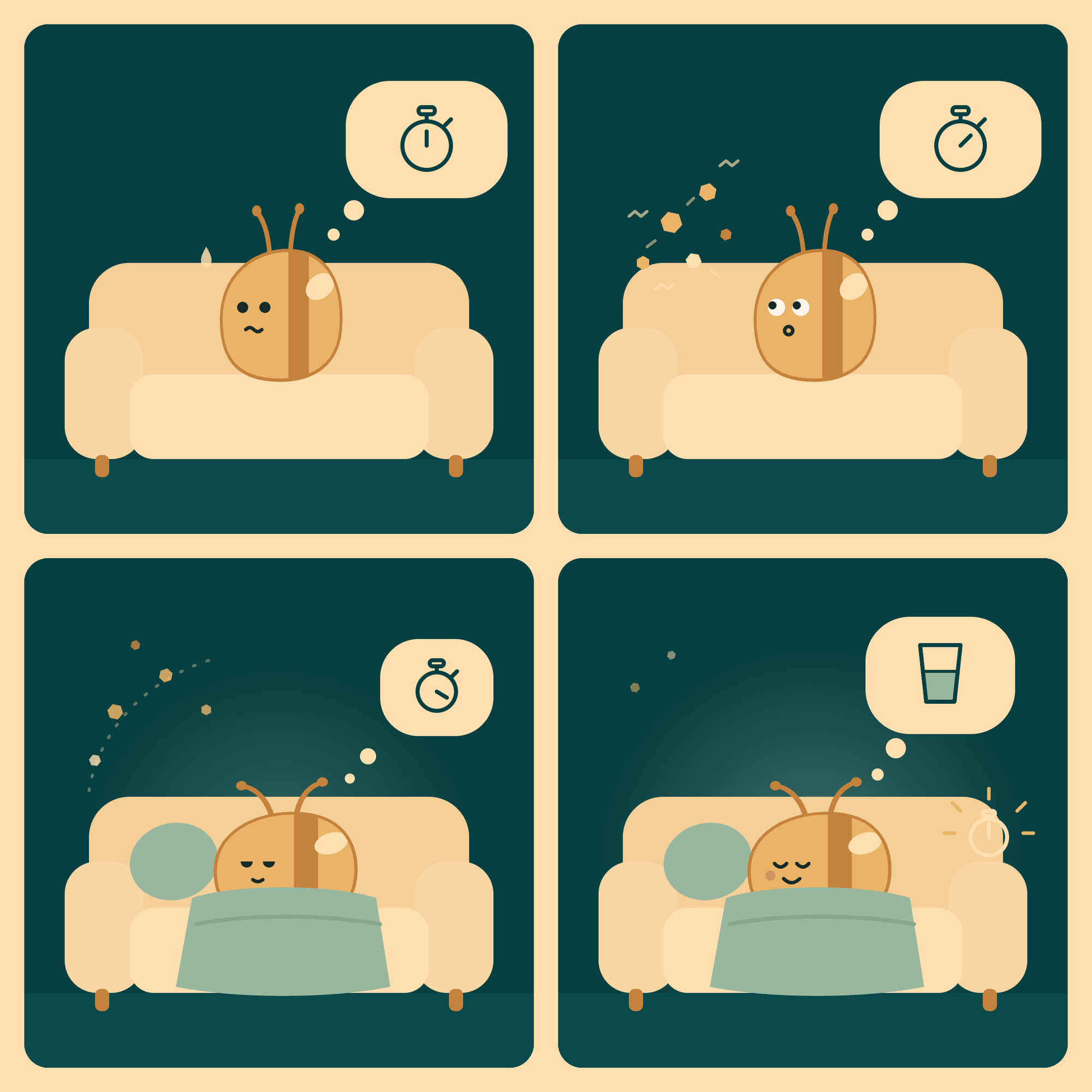
- Set up: set a timer for two minutes, put your phone face down and out of reach, and sit or lie somewhere comfortable.
- Breathe: let your breath settle, with each out-breath a little slower than the in-breath.
- Name it: notice the restlessness and say quietly, "this is the restless feeling."
- Let it be there: you don't have to fix it, argue with it or make it leave. If your mind runs off to the to-do list, that's fine. Come back to what you can feel: your feet, the seat beneath you, your hands.
- Stop when the timer goes: notice anything you noticed, however small, and do one kind thing, like a glass of water or a stretch.
The NHS says pausing for a few minutes to breathe can help you feel calmer, and two minutes is enough to start. The NHS also suggests setting aside a bit of "me time" away from work, such as a couple of nights a week. Little and often beats a big overhaul.
If it feels worse, that's useful information, not a failure. Stop whenever you like, and try again another day, or for less time.
Keep this for later: screenshot these five steps, or save the card below.
What not to do
There's a whole industry built around perfect rest, and it can make things worse. Three things are worth skipping:
- Forcing it. The harder you try to relax, the further away it tends to get.
- Turning rest into another job. The tracker, the 14-step evening routine, the gratitude journal you quietly resent. If it comes with a score, it's probably work.
- Judging yourself for not managing it. Being annoyed at yourself for feeling restless adds a second problem to the first.
Gentle and boring is plenty.
When to talk to someone
Not being able to relax now and then is a normal part of busy lives. It's worth speaking to your GP if restlessness or anxiety is constant, affects your daily life or sleep for several weeks, or comes with low mood, a racing heart or other symptoms that worry you. The NHS says the same: if you have symptoms you're worried about, or feel you have more severe stress, see a GP. Nothing here replaces that conversation.
Why can't I relax: frequently asked questions
Why can't I relax even when I have free time?
After long stretches of busy mode, stillness can feel unfamiliar. Your mind and body are used to being on, so quiet moments let restlessness, guilt or unfinished thoughts surface. That's common, and rest can feel easier with gentle practice.
Why does relaxing make me anxious?
Some people feel jittery or anxious when they slow down. Researchers call this relaxation-induced anxiety. It can happen when stillness feels unfamiliar or lets worries catch up. It's a description, not a diagnosis, and gentle, gradual practice often makes rest feel safer.
Is it normal to feel guilty when I rest?
Yes, it's very common. Many people link their worth to being useful, so resting can feel unearned. Noticing the guilt without obeying it is a good place to start, and it usually eases with practice.
How do I learn to relax if I am always busy?
Start small. Try two minutes of doing nothing in particular, and let any restlessness be there without fixing it. Short, regular pauses are easier to keep up than a big overhaul, and they build familiarity with rest.
Is not being able to relax a sign of anxiety?
It can be linked to anxiety, but it isn't proof of it. Stress, tiredness and habit can all make relaxing hard. If it's constant or affecting your daily life or sleep, speak to your GP.
What is relaxation-induced anxiety?
It's the experience of feeling anxious, tense or uneasy when you try to relax. It isn't an official diagnosis. It may happen when stillness feels unfamiliar or lets worries surface, and it's more common than most people expect. If it's frequent or distressing, a GP or therapist can help.
Your next step: two minutes of sitting with it
For tonight, or the next time rest feels strange, try the two minutes above and keep the card handy. And if you'd like more small, practical tools like this now and then, join the newsletter. It's free, and you can leave whenever you like.
Need to talk?
The Mind Hive is educational, not therapy, and it can’t replace support from a qualified professional.
If you’re struggling right now, please reach out: you can call Samaritans free on 116 123 at any time, contact NHS 111, or call 999 in an emergency.
Where this comes from
None of this replaces advice from your GP. These are the pages used, all opened on 12 November 2026:
- NHS Every Mind Matters, Stress
- NHS, 10 stress busters
- Heide, F. J. and Borkovec, T. D. (1983), Relaxation-induced anxiety: paradoxical anxiety enhancement due to relaxation training, Journal of Consulting and Clinical Psychology, 51(2), 171-182
- Medical News Today, article on relaxation-induced anxiety