Depression: signs, symptoms and how to get help in the UK
Not sure what you're feeling, or what happens if you ask for help? A plain-English UK guide to the signs, the tests and the routes to support.


Depression can show up as a low mood that doesn't lift, losing interest in things, tiredness, poor sleep and pulling away from people. If that sounds familiar, a GP is the usual first step, and in England you can also refer yourself to NHS Talking Therapies, or speak to an accredited private therapist. This guide explains the signs, the tests and what happens at each route to help.
You might be here because you've been feeling flat for a while and you're wondering what it is, whether it's "enough" to ask for help, and what would actually happen if you did. Those are sensible things to wonder, and you don't have to have it all worked out first.
A quick note on who we are: The Mind Hive isn't the NHS or a clinical service. This is general information to help you find your way, and it isn't a diagnosis or a substitute for talking to a professional.
If you're struggling right now
Please don't wait to finish reading. If you're having thoughts of harming yourself or of being better off dead, support is available right now, and you don't have to manage this alone.
- In immediate danger, or you've harmed yourself: call 999 or go to A&E.
- NHS 111 (England, Wales and Scotland): call 111 for urgent mental health help, any time.
- Northern Ireland: call Lifeline on 0808 808 8000, any time.
- Samaritans: call 116 123, free, 24 hours a day.
- Shout: text SHOUT to 85258, 24 hours a day.
- Under 19? Childline is free on 0800 1111.
The NHS lists these and other places to turn.
What are the signs and symptoms of depression?
The NHS describes depression as symptoms that last for weeks or months and are bad enough to affect work, social life and family life. It groups them like this:
- How you feel: an ongoing low mood or sadness, feeling hopeless or helpless, low self-esteem, tearfulness, guilt, irritability, little motivation or interest in things, trouble making decisions, and little enjoyment of life. Anxiety or worry can be part of it too.
- In your body: moving or speaking more slowly than usual, changes in appetite or weight, constipation, unexplained aches and pains, low energy, a lower sex drive, and disturbed sleep, such as trouble falling asleep or waking very early.
- In your life: avoiding friends, taking part in fewer social activities, neglecting hobbies and interests, and finding home, work or family life harder.
The NHS also lists thoughts of harming yourself as a possible symptom. If that's you, please use the list above.
This isn't a checklist for working out whether you have depression. Plenty of these can have other causes, and having a few of them doesn't mean you're depressed. Having none of them doesn't mean you're fine, either. What matters is how long it's lasted and how much it's getting in the way.
Am I depressed, or is it low mood?
The NHS says a low mood may improve after a short time. It suggests seeing a GP if you've felt low for more than two weeks, most of the day, every day. The NHS low mood page says something similar: low mood often gets better after a few days or weeks, and depression is possible if it lasts two weeks or more.
There's no way to settle it from the inside, and nobody expects you to. If it isn't going away, or you're struggling to cope, the right move is to ask someone who can look at the whole picture. If you'd like a gentler way to notice what's been changing first, our feeling low check-in is a free, private place to start. It doesn't score you or diagnose anything but it can offer some clarity into what's going on for you.
What are depression tests, and can they tell me if I'm depressed?
Searching "depression test" brings up a lot of online quizzes. Here's what to know about them:
- They can't diagnose depression. Only a health professional can, usually by talking with you about how you've been feeling and how it's affecting your life.
- The PHQ-9 is a short questionnaire. It's a nine-question form that asks how often you've been bothered by low mood and related problems over the last two weeks. NHS Talking Therapies services use it as a routine measure, alongside a conversation with a professional. It works as part of a conversation. On its own, a total can't tell you what you need.
If you do try an online test, treat the result as something to talk about, not an answer. A high number doesn't mean you're "very depressed", and a low one doesn't mean you're fine.
How to get help for depression in the UK
There are a few routes, and you can use more than one.
Route | Cost | Do you need a GP? | Good to know |
|---|---|---|---|
Your GP | Free on the NHS | You're seeing one | Usually the first step. They can talk through support and refer you on. |
NHS Talking Therapies (England) | Free | No, you can refer yourself | Aged 18 or over, or 16 in some areas. You don't need a diagnosis. |
Private health insurance | Depends on your policy | Often yes, for a referral | Cover varies a lot. Check before you book. |
A private therapist | You pay | No | You choose. Ask about fees before you start. |
Charities and helplines | Free | No | For listening and information, not treatment. |
Seeing your GP
The Mental Health Foundation says the first step to support is usually to visit your GP. A GP can give advice and, where appropriate, medication, and may refer you to more specialist services if they think it would help. Some people worry they're "making a fuss" or won't be taken seriously. You aren't, and GPs hear this often.
You don't need perfect words. It can help to say how you've been feeling, how long it's been going on, and how it's affecting your sleep, work or relationships. A few notes beforehand can help. If you've used our check-in, you can print your picture and bring that. If you don't feel heard, you can ask for another appointment or another GP at the surgery.
Referring yourself to NHS Talking Therapies
In England, the NHS says you can refer yourself without seeing a GP, and you don't need a diagnosed mental health condition. You need to be 18 or over, or 16 or over in some areas. Here's what the NHS says happens:
- You use the online service and enter the name of your GP surgery, so it can find therapy services in your area.
- The talking therapies service contacts you.
- If it can help, it tells you how long you may have to wait for a first session.
- It also explains what information it will share with your GP.
If you aren't registered with a GP, you may still be able to refer yourself, so check your local service. Routes differ in Scotland, Wales and Northern Ireland, so ask your GP about local psychological therapy services.
Private health insurance
Some private health insurance policies include mental health cover, and what they include varies a lot. As one example, AXA Health's own guide says its cover can include talking therapy such as CBT if your GP refers you, that there may be limits on the number of sessions, that some insurers only cover therapists on an approved list, and that conditions you already have may not be covered at first. That's an insurer describing its own product, so treat it as an example, not a rule.
If you have a policy, or one through work, ask the insurer what's covered, whether you need a GP referral, and how many sessions you get, before you book anything.
Private therapists
Private therapy is another route if you can afford it. The BACP therapist directory and NCPS therapist directory list counsellors and psychotherapists who are members of the British Association for Counselling and Psychotherapy. It's a directory of paying members rather than an endorsement. Fees vary, so ask what a session costs and how many you might need before you start. We'd start with the NHS and your GP, and we don't recommend any one service.
Charities and helplines
Mind offers information and support, but it isn't a crisis service. Its Infoline is 0300 123 3393. Samaritans are on 116 123, any time, for anyone who needs to talk.
These services are in the UK. If you're reading from elsewhere, your local health service or emergency number is the right place to start.
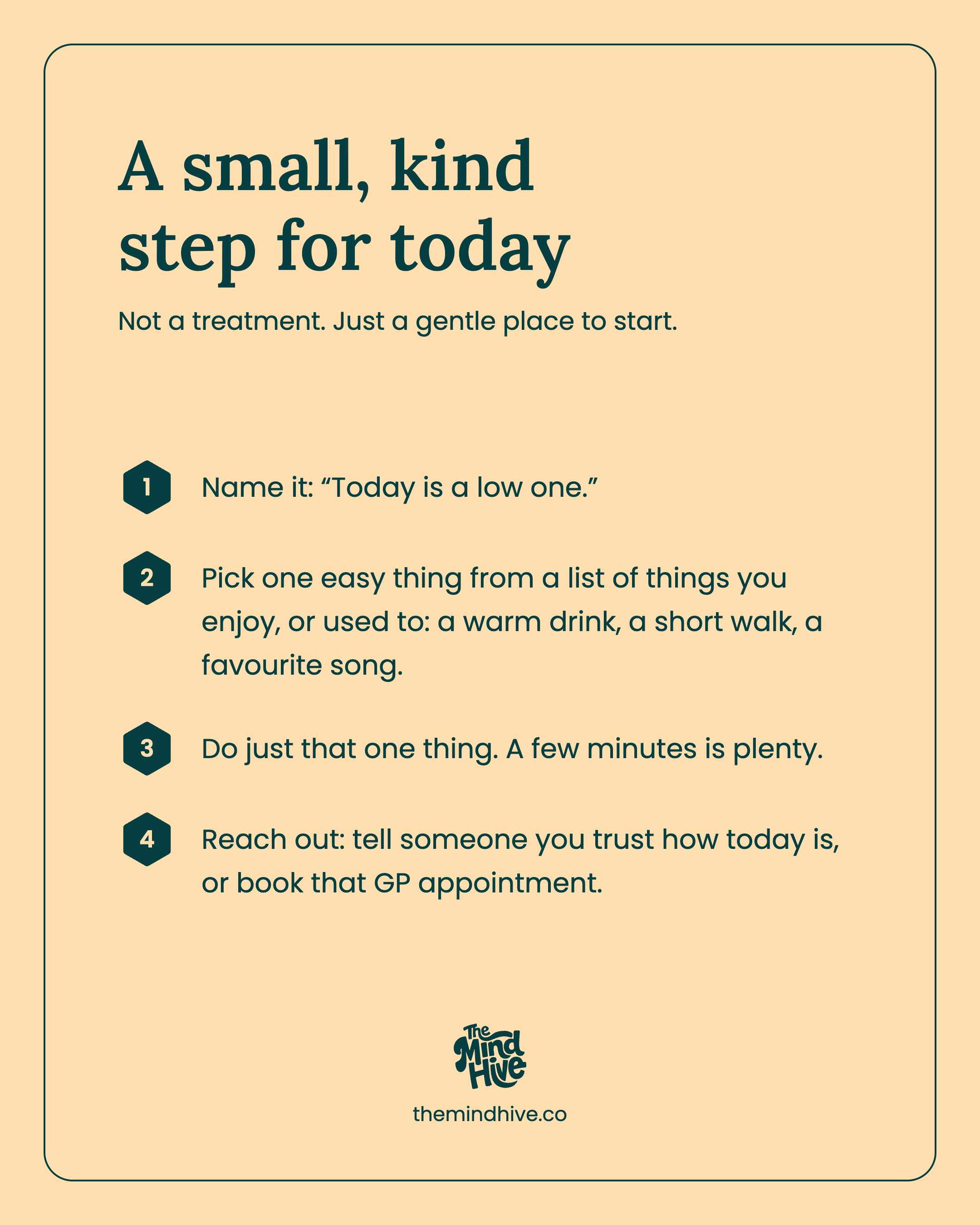
A small, kind step for today
While you decide what to do, or wait for an appointment, here's something small. It isn't a treatment, and it doesn't need to work perfectly. It's just a gentle place to start.
- Name it: "Today is a low one."
- Pick one easy thing from a list of things you enjoy, or used to: a warm drink, a short walk, a favourite song.
- Do just that one thing. A few minutes is plenty.
- Reach out: tell someone you trust how today is, or book that GP appointment.
The NHS suggests making a list of activities you enjoy and doing some each day, starting with the easier ones, and reaching out to trusted friends, family or colleagues, or a helpline, when you're struggling.
Keep this for later: screenshot the four steps above, or save the card below.
Depression and burnout: how do they differ?
They can overlap, and it isn't always easy to tell them apart from the inside. Burnout tends to build alongside ongoing strain, often at work, while low mood can come from many places. Neither is a diagnosis here. If it's more a worn-out feeling, our burnout quiz is a gentle place to start, and it doesn't replace talking to your GP. If worry or stress is a big part of it, our stress and worry check-in may help [add link once live]. You can also read our anxiety guide.
Depression: frequently asked questions
What are the main signs of depression?
The NHS lists an ongoing low mood or sadness, feeling hopeless, little motivation or interest in things, low energy, disturbed sleep and pulling away from friends and activities. They last for weeks or months and affect daily life. If that sounds like you, speak to your GP.
Can an online depression test tell me if I have depression?
No. An online test can help you reflect on how you've been feeling, but only a health professional can diagnose depression, usually after talking with you. Think of any result as something to take to a conversation with your GP, not an answer.
What is the PHQ-9?
The PHQ-9 is a nine-question form that asks how often you've been bothered by low mood and related problems over the last two weeks. NHS Talking Therapies services use it as a routine measure, alongside a conversation with a professional. On its own, a total can't tell you what you need.
How long does low mood have to last before I see a GP?
The NHS says a low mood may improve after a short time, and suggests seeing a GP if it has lasted more than two weeks, most of the day, every day. If you're struggling to cope, don't wait: speak to your GP or call NHS 111.
Do I need a GP to get NHS talking therapy?
No. In England you can refer yourself to NHS Talking Therapies without seeing a GP, and you don't need a diagnosis. The NHS says you need to be 18 or over, or 16 or over in some areas. Routes differ in Scotland, Wales and Northern Ireland.
What should I do if I am having thoughts of harming myself?
Please reach out now. Call Samaritans free on 116 123 at any time, or 999 if you're in immediate danger. In England, Wales and Scotland you can call NHS 111, and in Northern Ireland, Lifeline on 0808 808 8000. You can also tell your GP or someone you trust.
Your next step
You don't have to work this out today. One small step is plenty, and the clearest one is a conversation with your GP. If you'd like more small, practical tools like this now and then, join the newsletter. It's free, and you can leave whenever you like.
Need to talk?
The Mind Hive shares everyday tools for reflection. It isn't medical advice or a substitute for professional care. If you feel unable to cope or unsafe, call Samaritans free on 116 123, or 999 in an emergency.
Where this comes from
None of this replaces advice from your GP. These are the pages used, all opened on 13 November 2026 except Mind's:
- NHS, Symptoms of depression
- NHS, Low mood, sadness or depression
- NHS, What happens when you refer yourself to NHS Talking Therapies
- NHS, Help for suicidal thoughts
- Mental Health Foundation, How to talk to your GP about your mental health
- AXA Health, Does health insurance cover mental health issues? (an insurer's own page, used as an example)
- BACP, Using our therapist directory
- NI Direct, Lifeline
- Samaritans, Contact a Samaritan
- NHS England, NHS Talking Therapies manual v7.1, for the PHQ-9 as a routine measure