Anxiety: signs, symptoms and how to get help in the UK
Not sure whether it's worry, stress or anxiety, or what happens if you ask for help? A plain-English UK guide to the signs, the tests and the routes to support.


Anxiety can show up in your body, your mind and what you do: a racing heart, a busy mind, trouble sleeping, avoiding things. It overlaps with stress and worry, and you don't need to work out which it is before asking for help. A GP is the usual first step, and in England you can also refer yourself to NHS Talking Therapies. This guide explains the signs, the tests and what happens at each route.
You might be here because your mind has been busy for a while, or your body has been telling you something, and you're wondering what it is and whether it's worth asking about. Those are sensible things to wonder, and you don't need the right words first.
A quick note on who we are: The Mind Hive isn't the NHS or a clinical service. This is general information to help you find your way, and it isn't a diagnosis or a substitute for talking to a professional.
If you're struggling right now
If you need help now, please use one of these before anything else on this page:
- In immediate danger, or you've harmed yourself: call 999 or go to A&E.
- NHS 111 (England, Wales and Scotland): call 111 or use 111 online and choose the mental health option.
- Northern Ireland: call Lifeline free on 0808 808 8000, any time.
- Samaritans: call free on 116 123, at any time.
- Shout: text SHOUT to 85258 for free, confidential support, 24/7.
- Under 19? Childline is free on 0800 1111.
What are the signs and symptoms of anxiety?
The NHS says anxiety can show up in your body, your mind and your behaviour:
- In your body: feeling shaky or trembly, dizzy or sweating more, pins and needles, headaches, stomach aches, muscle pain, a dry mouth, or a heartbeat that feels stronger, faster or irregular.
- In your mind: tiredness, restlessness or irritability, trouble concentrating or making decisions, and worrying about the past or the future.
- In what you do: sleep problems, or avoiding people and situations that set off the anxiety.
That's a long list, and it isn't a checklist for diagnosing yourself. Lots of these can have other causes. The NHS suggests seeing a GP if you can't tell whether something like shortness of breath is caused by anxiety, or if you're worried about any other symptoms.
Panic attacks and anxiety attacks
People use "panic attack" and "anxiety attack" in different ways, and the NHS page we used talks about panic attacks. The NHS describes them as frightening but not dangerous, and says they usually last between 5 and 20 minutes. If you get them, or you're not sure what they are, a GP can help, and it's worth getting any chest pain or breathing difficulty checked rather than assuming.
Anxiety, stress or worry?
They overlap, and the lines between them aren't sharp. The NHS describes stress as the body's reaction to feeling threatened or under pressure, and lists feeling worried, anxious or scared among its common signs. Long-term or severe stress can lead to exhaustion, often called burnout.
A rough way to think about it: stress and worry tend to have something you can point at, like a deadline, a bill or a conversation, while anxiety can keep going when the thing has passed or there's no obvious reason. That's a rule of thumb, not a test. If it's taking up a lot of space or getting in the way of daily life, it's worth talking to someone, whatever name it has.
If you'd like a gentle way to notice what's been weighing on you first, our stress and worry check-in is a free, private place to start. It doesn't score you or diagnose anything.
What are anxiety tests, and can they tell me if I have anxiety?
Searching "anxiety test" brings up a lot of online quizzes. Here's what to know about them:
- They can't diagnose anxiety. The NHS says a GP assesses anxiety by asking about your worries and physical symptoms, and encourages you to be honest, even when it's hard to talk about your emotions.
- The GAD-7 is a short questionnaire. It's a seven-question form that asks how often you've been bothered by worry, tension and related problems over the last two weeks. NHS Talking Therapies services use it as a routine measure, alongside a conversation with a professional. On its own, a total can't tell you what you need.
If you do try an online test, treat the result as something to talk about, not an answer.
How to get help for anxiety in the UK
There are a few routes, and you can use more than one.
Route | Cost | Do you need a GP? | Good to know |
|---|---|---|---|
Your GP | Free on the NHS | You're seeing one | Usually the first step. They can talk through support and refer you on. |
NHS Talking Therapies (England) | Free | No, you can refer yourself | Aged 18 or over, or 16 in some areas. You don't need a diagnosis. |
Private health insurance | Depends on your policy | Often yes, for a referral | Cover varies a lot. Check before you book. |
A private therapist | You pay | No | You choose. Ask about fees before you start. |
Charities and helplines | Free | No | For listening and information, not treatment. |
Seeing your GP
The Mental Health Foundation says the first step to support is usually to visit your GP. A GP can give advice and, where appropriate, medication, and may refer you to more specialist services if they think it would help. Some people worry they're "making a fuss" or won't be taken seriously. You aren't, and GPs hear this often.
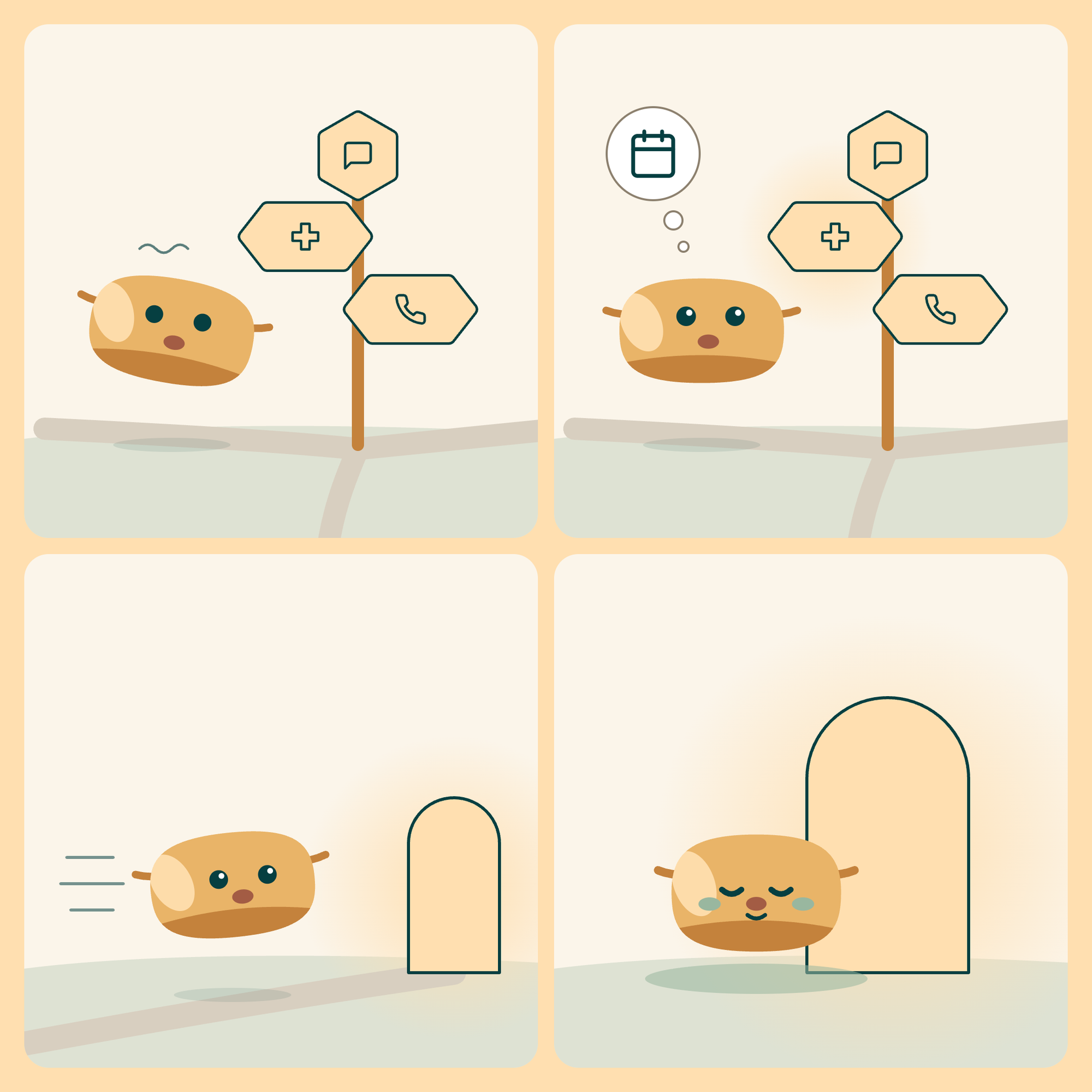
You don't need perfect words. Something like "I've been feeling anxious and it's getting in the way" is plenty. It can help to say what you notice in your body and mind, how long it's been going on, and what it stops you doing. The NHS suggests keeping a diary of what you do and how you feel, which can show patterns behind the anxiety and may help when you talk to a GP. If you've used our check-in, you can print your picture and bring that.
Referring yourself to NHS Talking Therapies
In England, the NHS says you can refer yourself without seeing a GP, and you don't need a diagnosed mental health condition. You need to be 18 or over, or 16 or over in some areas. Here's what the NHS says happens:
- You use the online service and enter the name of your GP surgery, so it can find therapy services in your area.
- The talking therapies service contacts you.
- If it can help, it tells you how long you may have to wait for a first session.
- It also explains what information it will share with your GP.
If you aren't registered with a GP, you may still be able to refer yourself, so check your local service. Routes differ in Scotland, Wales and Northern Ireland, so ask your GP about local psychological therapy services.
Private health insurance
Some private health insurance policies include mental health cover, and what they include varies a lot. As one example, AXA Health's own guide says its cover can include talking therapy such as CBT if your GP refers you, that there may be limits on the number of sessions, that some insurers only cover therapists on an approved list, and that conditions you already have may not be covered at first. That's an insurer describing its own product, so treat it as an example, not a rule.
If you have a policy, or one through work, ask the insurer what's covered, whether you need a GP referral, and how many sessions you get, before you book anything.
Private therapists
Private therapy is another route if you can afford it. The BACP therapist directory and NCPS therapist directory list counsellors and psychotherapists who are members of the British Association for Counselling and Psychotherapy. It's a directory of paying members rather than an endorsement. Fees vary, so ask what a session costs and how many you might need before you start. We'd start with the NHS and your GP, and we don't recommend any one service.
Charities and helplines
Mind offers information and support, but it isn't a crisis service. Its Infoline is 0300 123 3393. Samaritans are on 116 123, any time, for anyone who needs to talk.
These services are in the UK. If you're reading from elsewhere, your local health service or emergency number is the right place to start.
A small pause for a busy mind
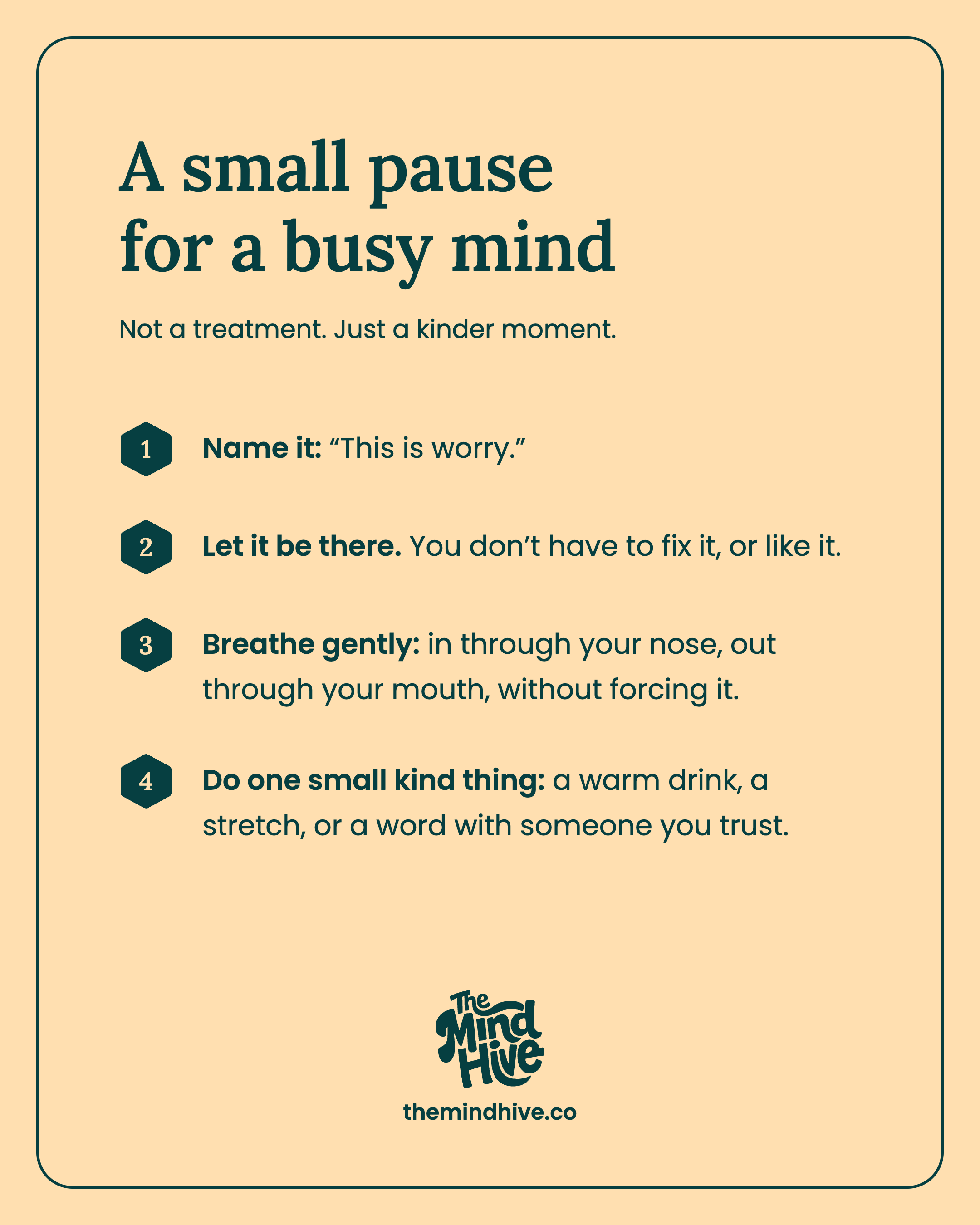
Waiting for an appointment can feel long. While you do, here's a small, gentle pause you can try. It isn't a treatment, and it doesn't need to work perfectly. It's just a way of being a little kinder to yourself in the meantime.
- Name it: "This is worry."
- Let it be there. You don't have to fix it, or like it.
- Breathe gently: in through your nose, out through your mouth, without forcing it.
- Do one small kind thing: a warm drink, a stretch, or a word with someone you trust.
The breathing step follows the NHS breathing exercise for stress, which suggests breathing in through your nose and out through your mouth, as deeply as is comfortable and without forcing it.
Keep this for later: screenshot the four steps above, or save the card below.
Anxiety, tired but wired or overthinking?
Worry doesn't always announce itself. Sometimes it shows up as not being able to switch off at night. If that sounds familiar, our guide to why your body won't switch off when you're exhausted and the tired-but-wired quiz may help you notice what's going on. If it's more a long-running, worn-out feeling, the burnout quiz is a gentle place to start. If low mood is part of the picture, you can read our depression guide. These overlap, none of them is a diagnosis, and none replaces talking to your GP.
Anxiety: frequently asked questions
What are the main signs of anxiety?
The NHS says anxiety can bring a racing or irregular heartbeat, feeling shaky, dizzy or sweaty, stomach aches, restlessness, trouble concentrating, sleep problems and avoiding people or situations. Many of these have other causes too, so if they worry you or keep happening, speak to your GP.
What is the difference between anxiety and stress?
The NHS describes stress as the body's reaction to feeling threatened or under pressure, and lists feeling worried or anxious as a common sign of it. The two overlap, and you don't need to work out which it is before asking for help. If it affects your daily life, speak to your GP or call NHS 111.
Can an online anxiety test diagnose me?
No. A questionnaire can help you reflect on how you've been feeling, but only a health professional can diagnose anxiety, usually by talking with you about your worries and physical symptoms. Think of any result as something to take to a conversation with your GP, not an answer.
What is the GAD-7?
The GAD-7 is a seven-question form that asks how often you've been bothered by worry, tension and related problems over the last two weeks. NHS Talking Therapies services use it as a routine measure, alongside a conversation with a professional. On its own, a total can't tell you what you need.
How do I get help for anxiety in the UK?
Start with your GP, who can talk through options. In England, you can also refer yourself to NHS Talking Therapies without seeing a GP first, and the NHS says people aged 18 or over, or 16 in some areas, can do this. Routes differ in Scotland, Wales and Northern Ireland, so check your local NHS service.
When should I see a GP about anxiety?
If anxiety is affecting your daily life, you're struggling to cope, or what you try yourself isn't helping, speak to your GP or contact NHS 111. If you feel unable to keep yourself safe, call 999 or go to A&E. You can also call Samaritans free on 116 123.
Your next step
A worry noticed is plenty for today. Whatever you decide, you don't have to sort it all out in one go. If you'd like more small, practical tools like this now and then, join the newsletter. It's free, and you can leave whenever you like.
Need to talk?
The Mind Hive shares everyday tools for reflection. It isn't medical advice or a substitute for professional care. If you feel unable to cope or unsafe, call Samaritans free on 116 123, or 999 in an emergency.
Where this comes from
None of this replaces advice from your GP. These are the pages used, all opened on 13 November 2026 except Mind's:
- NHS Every Mind Matters, Anxiety
- NHS Every Mind Matters, Stress
- NHS, Anxiety, fear and panic
- NHS, Generalised anxiety disorder in adults: diagnosis
- NHS, Breathing exercises for stress
- NHS, What happens when you refer yourself to NHS Talking Therapies
- NHS, Where to get urgent help for mental health
- Mental Health Foundation, How to talk to your GP about your mental health
- AXA Health, Does health insurance cover mental health issues? (an insurer's own page, used as an example)
- BACP, Using our therapist directory
- NHS England, NHS Talking Therapies manual v7.1, for the GAD-7 as a routine measure