
Tired but wired: why your body won't switch off when you're exhausted
Exhausted, but your body won't settle? Here's what 'tired but wired' means, why it happens, and one small wind-down step to try tonight.


Tired but wired is that frustrating mix of being exhausted yet unable to switch off. Your body is worn out, but your nervous system is still in "on" mode and your mind is still working. It's common, it isn't a character flaw, and small wind-down habits can help.
You know the scene. It's gone eleven, you've been running on fumes since mid-afternoon, and the moment your head meets the pillow, your brain sits up and starts taking minutes. The email you didn't send. Something you said in 2019. Whether you actually own any bin bags.
If that's you, nothing is wrong with you. You're not bad at sleeping, and you're not failing at rest—despite what your fitness watch might be yelling at you. Your body and your mind have simply fallen out of step, and there's an ordinary explanation for it.

What does "tired but wired" actually mean?
"Tired but wired" isn't a medical term. It's the everyday phrase for a mismatch: your body feels depleted while your mind, or the part of you that keeps watch, stays switched on.
It tends to show up in ways like these:
- You're lying in bed, heavy-eyed, replaying the day on a loop.
- You're wide-eyed imagining all the things that could go wrong tomorrow.
- You've had a third coffee at 4pm and feel jittery and flat at the same time.
- You're snappy and numb in the same hour, and can't quite say which one is worse.
It's a mental-exhaustion kind of tiredness, the sort a nap doesn't quite fix, which is partly why it's so confusing. You're tired enough to drop, but the part of you that should let you drop has gone on strike.
Why does it happen? Three plain reasons
There isn't one cause, and it's worth saying plainly that we can't tell from the outside which of these is yours. But three things come up again and again.
Your body is still in "on" mode
Your body has a built-in alarm system, designed to get you ready for whatever needs dealing with. The trouble is that it doesn't separate a genuine emergency from a heavy week, a full inbox or a tricky conversation. After a long, demanding day, it doesn't always get the memo that the danger has passed.
Think of a fan that keeps spinning for a while after you flick the switch. You've stopped. The motor hasn't.
The NHS notes that stress and anxiety can make it harder to switch off and sleep, and that it's common to lie there with a busy mind.
Your mind is still working
Unfinished things nag. Your mind keeps open loops, the replies you owe, the things you meant to do, the thing you're not sure you said right, and during the day, noise and busyness keep them politely in the queue. At night, with nothing else to do, they step forward all at once.
Sleep specialists at the American Academy of Sleep Medicine describe the same pattern: once the distractions fade, there's finally room for the thoughts you set aside earlier.
This isn't your mind being difficult. It's trying to help you remember and prepare. It just has terrible timing.
There's been no real wind-down
A lot of days run flat out right up to the moment we stop: emails after work, sorting out the kids, one more scroll in bed, more coffees than you'd care to admit. There's no runway. It's like trying to go from sixty to zero without any brakes in between, and then wondering why it feels abrupt.
The NHS suggests making time to relax before bed and cutting back on caffeine and alcohol in the evening. Not thrilling advice, but there's a reason it keeps being repeated.
None of this is a moral failing. It's often just what a full life looks like. But it does mean the switch from "on" to "off" has very little to work with.
Tired but wired, burnout or poor sleep: how do they differ?
They can overlap, and none of this is a diagnosis. But a rough sketch can help you work out what you're dealing with.
Tired but wired | Burnout | A run of poor sleep | |
|---|---|---|---|
What it feels like | Exhausted, but keyed up and unable to settle | Drained, flat or cynical, even about things you used to care about | Tired because you haven't slept enough or well |
Usual pattern | Often at night or bedtime, after a demanding day | Builds over weeks or months alongside ongoing strain | Can follow a stressful patch, a routine change, or disturbed nights |
Worth a chat with your GP if | It goes on for several weeks | It's affecting your daily life or mood | It's most nights for weeks |
If the burnout column rings more true, what does burnout feel like? goes into it in more detail.
What helps (without forcing sleep)
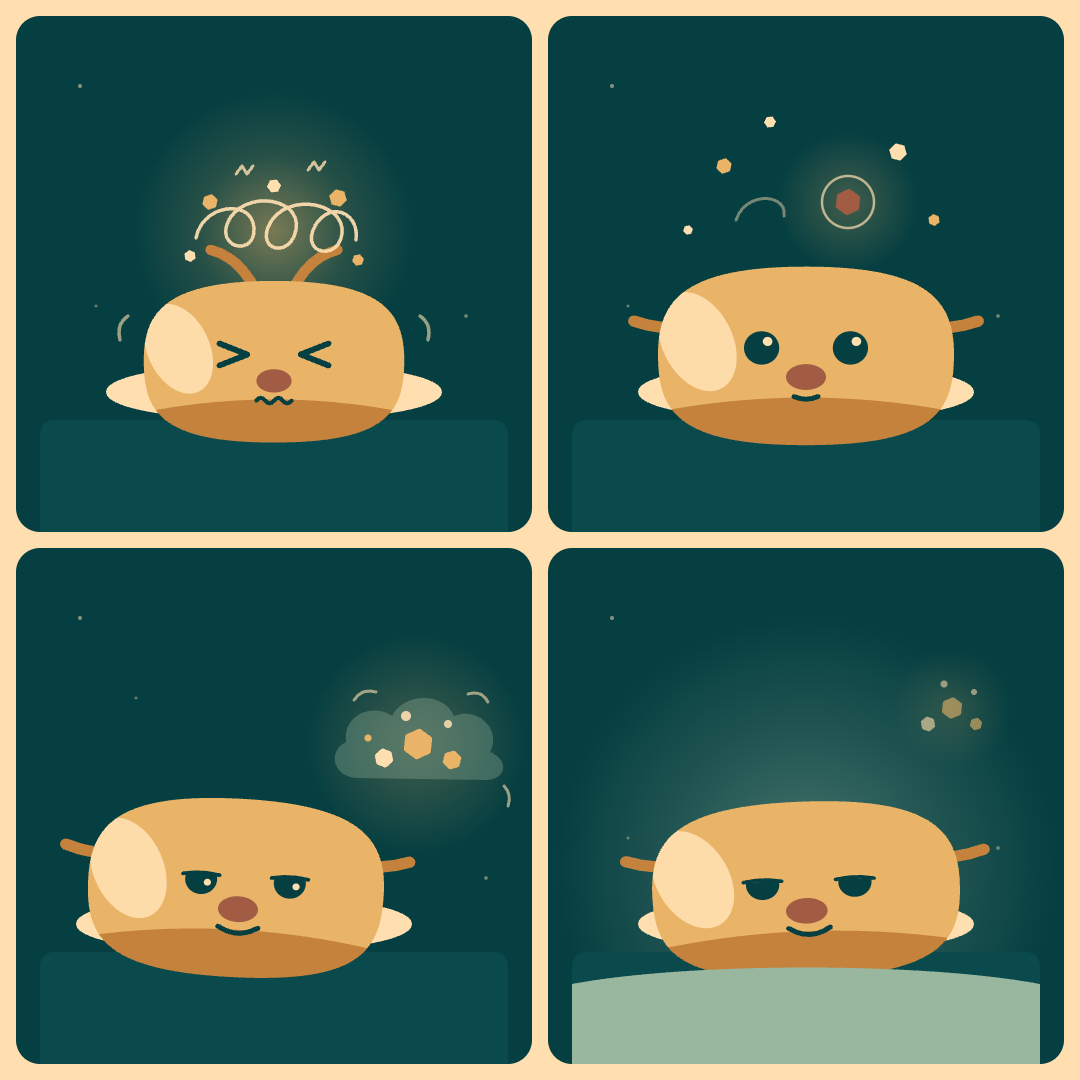
Here's the awkward truth about sleep: the harder you try to make it happen, the further away it tends to get. Trying to force yourself to relax is a bit like trying to win a tug of war with someone who is also you.
So instead of pulling harder, try loosening your grip.
Make room for the buzz
Notice the wired feeling. Name it, quietly and without drama: "this is the wired feeling." Then let it be there, the way you'd let a noisy neighbour be noisy without going round to complain at midnight.
You don't have to like it. You're just not adding a second problem, being annoyed at yourself for having the first.
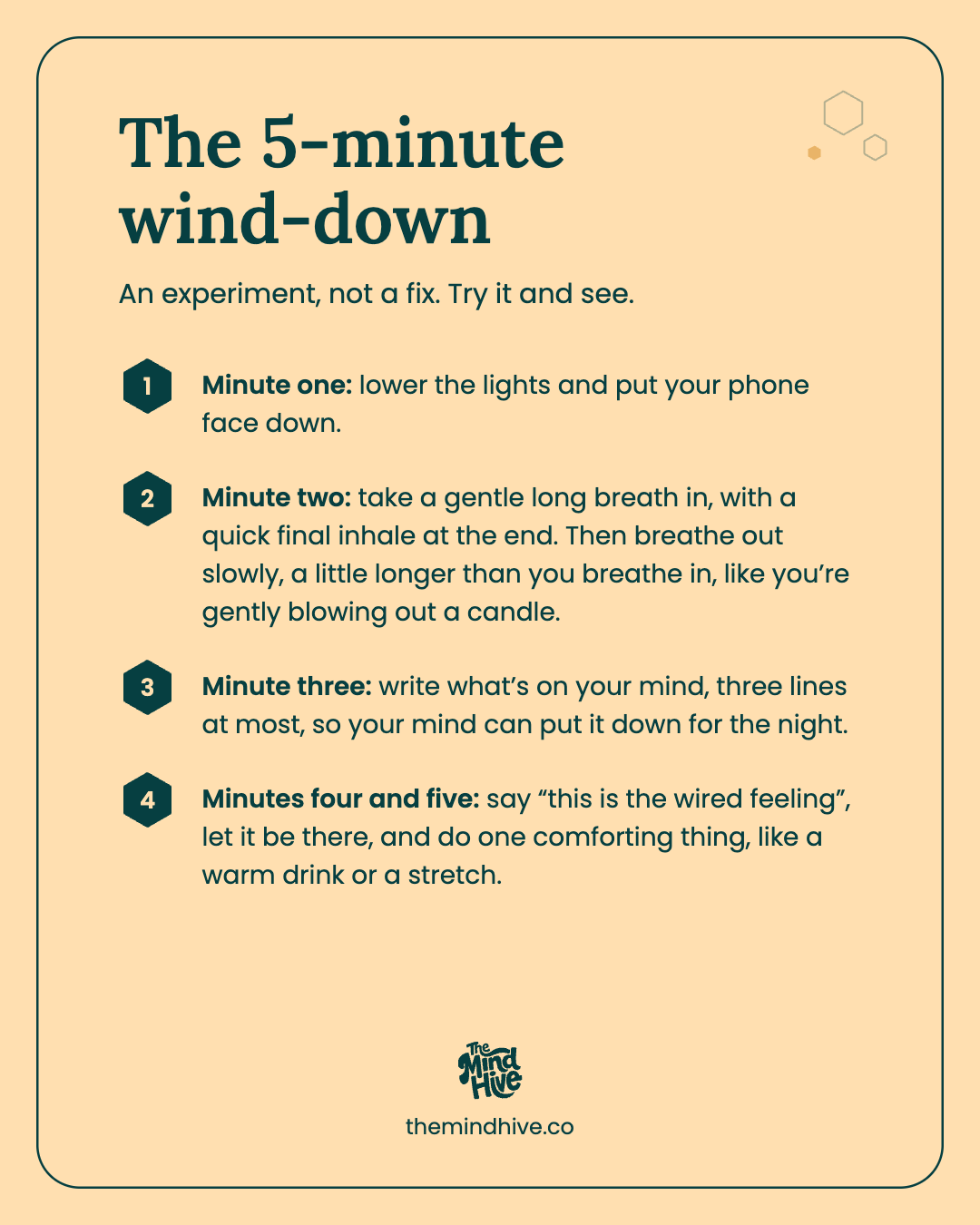
Try the 5-minute wind-down
This is an experiment, not a fix. Try it and see what happens.
- Minute one: lower the lights and put your phone face down.
- Minute two: take a gentle long breath in, with a quick final inhale at the end. Then, breathe out slowly, a little longer than you breathe in—like you're gently blowing out a candle.
- Minute three: write what's on your mind, three lines at most, so your mind can put it down for the night.
- Minutes four and five: say "this is the wired feeling", let it be there, and do one comforting thing, like a warm drink or a stretch.
Writing worries down is a staple of sleep advice. Sleepio's Professor Colin Espie is among the experts who recommend it for a racing mind.
Keep this for later: screenshot the five minutes above, or save the card below.
What to skip
There's a whole industry built around perfect nights, and it can make things worse. Watching the clock, doing sleep sums at 2am, or trying out a new "hack" every week can all turn bedtime into a performance. Gentle and boring is plenty.
When to talk to your GP
Being tired but wired now and then is a normal part of busy lives. It's worth speaking to your GP if it goes on for several weeks, affects your daily life, or comes with low mood, a racing heart or other symptoms that worry you. They can check for physical causes and talk through support. Nothing here replaces that conversation.
The NHS gives similar advice about tiredness that lasts, and the page on insomnia says to see a GP if sleep problems are affecting your life or haven't improved with self-help.
Tired but wired: frequently asked questions
Why am I tired but wired?
Usually because your body is worn out while your nervous system is still switched on. Stress, a busy mind, late caffeine or screens, and no real wind-down can all keep you alert after a long day. It's a common experience rather than a medical diagnosis.
Is feeling tired but wired a sign of anxiety?
It can overlap with anxiety, because worry keeps the body on alert. But being tired but wired is a description, not a diagnosis. If it comes with persistent worry, panic or low mood, it's worth talking to your GP.
Is being tired but wired a sign of ADHD?
Not necessarily. Restlessness and a busy mind can be part of ADHD, and some adults find it hard to wind down at night. But the same things happen with stress, caffeine and full lives. If you recognise lifelong patterns of restlessness or distractibility, ask your GP about an assessment.
Why do I feel more awake at night?
Many people feel a late-evening burst of alertness after a busy day, caffeine, screens or unfinished worries. Body clocks also differ. If your nights are regularly disrupted for several weeks, mention it to your GP.
How do I calm down when I am exhausted but cannot sleep?
Try not to force sleep. Dim the lights, breathe out a little longer than you breathe in, and write tomorrow's list down so your mind can put it down. Rest without sleeping still helps, and it can ease the pressure.
Is tired but wired the same as burnout?
Not exactly. Tired but wired describes how you feel right now, while burnout is a longer build-up of exhaustion from sustained stress. They can overlap, and neither is a diagnosis on this site. If you're worried, speak to your GP.
When should I see a GP about constant tiredness?
If tiredness lasts several weeks, affects your daily life, or comes with other symptoms such as low mood, a racing heart or unexplained changes, see your GP. Your GP can check for physical causes and talk through support.
Your next step: the 5-minute wind-down
If rest feels uncomfortable even when you finally have the time, you might also like Why can't I relax?.
For tonight, try the wind-down above, and keep the card handy if you'd like. And if you'd like more small, practical tools like this now and then, join the newsletter. It's free, and you can leave whenever you like.
Need to talk?
The Mind Hive is educational, not therapy, and it can’t replace support from a qualified professional.
If you’re struggling right now, please reach out: you can call Samaritans free on 116 123 at any time, contact NHS 111, or call 999 in an emergency.